
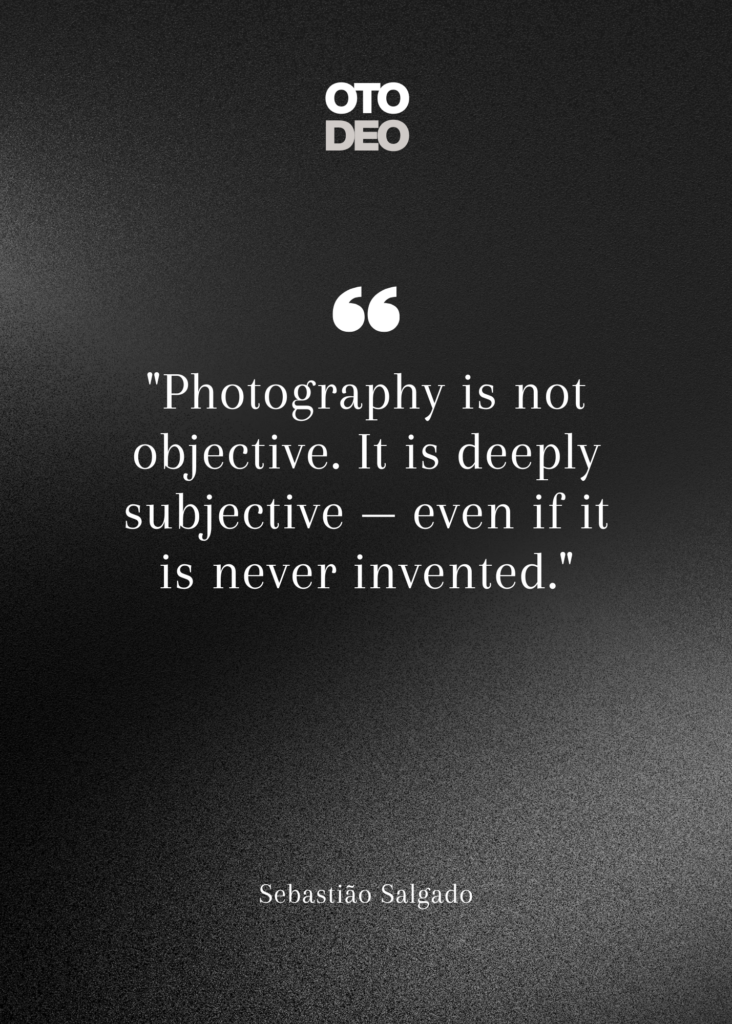
| “Photography is not objective. It is deeply subjective — even if it is never invented.” — Sebastião Salgado |
The client who emails you asking for your “going rate” and comparing you to three other photographers they found on Google is not being difficult. They’re operating from a completely understandable assumption: that photography is a commodity, that one photographer is broadly interchangeable with another, and that price is the relevant differentiating variable.
Salgado’s quote is the most elegant rebuttal to that assumption. Photography is deeply subjective. The photographer behind the camera is the product — not the camera, not the number of images delivered, not the hours of coverage. And because subjectivity is the product, choosing a photographer purely on price is like choosing a therapist based on their hourly rate. You’re missing the actual variable that determines the outcome.
Who Is Sebastião Salgado?
Sebastião Salgado is a Brazilian documentary photographer whose decades of work in conflict zones, famine-stricken regions, and the world’s most remote landscapes produced some of the most powerful social photography in history. His Workers series documented industrial labor on a global scale; his Genesis project spent eight years photographing untouched natural landscapes. His work is immediately recognizable — the light, the scale, the humanity — in a way that makes Salgado’s subjectivity the most commercially valuable thing about his portfolio.
The Business Lesson: Make Your Subjectivity Legible to Clients
The problem isn’t that clients don’t understand that photography is subjective. The problem is that most photographers don’t help them understand what that subjectivity means in practical terms.
When a client compares you to a photographer who charges half your rate, they’re treating both of you as objective service providers. The way to exit that comparison is to make your subjectivity visible — to show them that what you see and how you capture it is fundamentally different, in a way that matters to their specific situation.
This is a communication problem as much as a positioning problem. It means being able to articulate your approach — not in technical terms, but in human ones. Not “I shoot with a Canon R5 and edit in Lightroom” but “I look for the moment where someone stops performing and becomes real. That’s the frame I’m waiting for every single session.”
Real-World Application: Write Your Photographer’s Statement
That kind of language makes your subjectivity tangible. It gives clients something to evaluate beyond price. And it attracts the clients who specifically want what you specifically do — which means fewer price negotiations and more of the work you love.
In 2-3 sentences, describe what you’re looking for when you’re shooting. Not technically — humanly. What are you paying attention to? What makes you press the shutter?
Put that statement on your website. In your inquiry response. On your Instagram bio. Let it do the work of making your subjectivity visible before the price conversation even starts.
The clients who respond to it are yours. The ones who don’t were going to book you at full price anyway.
Take the Next Step
The OTODEO Complete Marketing Checklist includes a section on brand voice and positioning that helps you communicate your subjectivity consistently across every client touchpoint. Get it free at otodeo.com/complete-marketing-checklist.
More from Otodeo
- Quote of the Day – Joe Edelman on Treating Photography Like a Business and the System That Makes Consistent Bookings Possible
- Quote of the Day – Lara Jade on Relationships vs. Transactions and the Follow-Up Gap That Kills Photography Bookings
- Quote of the Day – Chris Burkard on Curiosity, Exploration, and Turning Your Photography Journey Into Content That Books Clients
- Quote of the Day – Martin Schoeller on Proximity, Clarity, and Why Photographers Who Niche Down Book Better Clients
- Quote of the Day – Platon on Trust, Safety, and the Photographer-Client Relationship That Drives Referrals

