

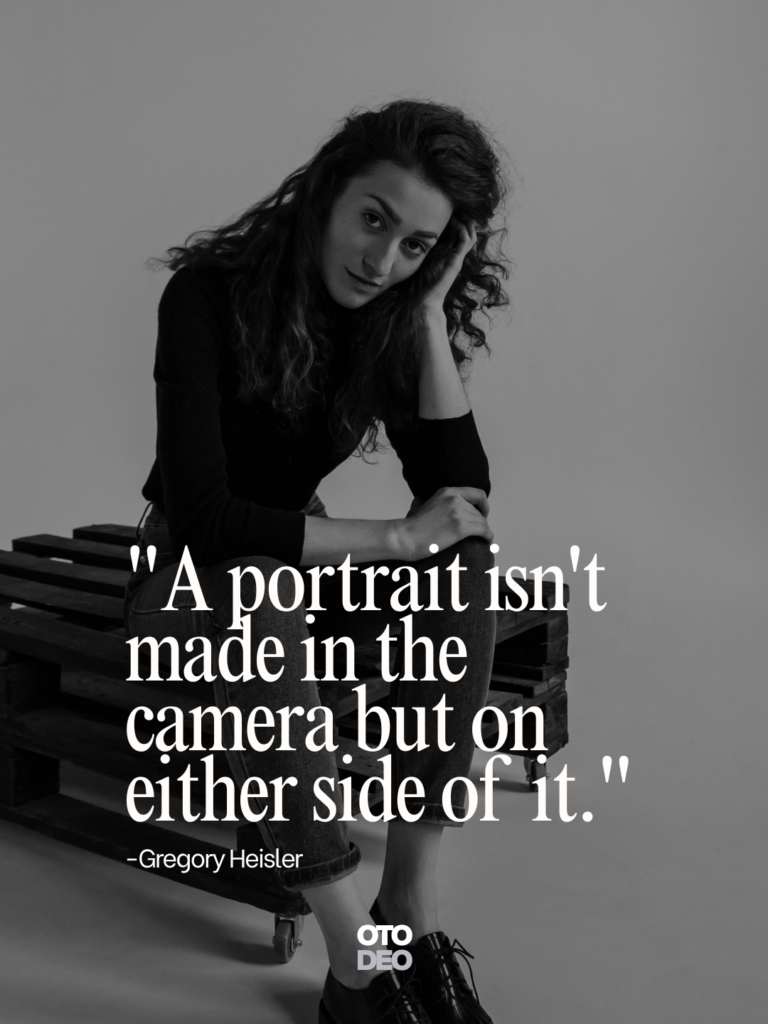
| “A portrait isn’t made in the camera but on either side of it.” — Gregory Heisler |
On either side of it. Before the shutter fires and after.
The moment between — the actual technical act of photography — is almost the smallest part of a great portrait experience. What happens before it (the conversation, the trust-building, the creative brief, the preparation) and after it (the delivery, the curation, the reveal, the follow-up) determines whether the image becomes something the client treasures or something they keep meaning to frame.
Most photographers have mastered the middle. The opportunity is on both sides.
Who Is Gregory Heisler?
Gregory Heisler is one of the most respected portrait photographers in editorial history, best known for his Time magazine covers and his book 50 Portraits, which documents his process on fifty of his most significant shoots. His work is technically extraordinary — he’s famous for his complex, precisely controlled lighting setups — but what sets him apart is his understanding that lighting is in service of a human relationship. The technical execution supports the connection. Not the other way around.
The Business Lesson: Design the Experience Around Both Sides
Most photographers have a defined workflow for the shoot itself. Camera settings, lighting setup, posing cues, and location scouting. That’s the middle — and most of them do it well.
The past is often underdeveloped. What does the client experience between booking and the session day? Do they receive a thoughtful session guide that sets them up for success, or do they get a confirmation email and radio silence? Do you do a phone or video call before the session, or does the first real conversation happen when you meet in person, and the clock is already running? Are they arriving nervous and unprepared, or settled and excited?
The after is even more neglected. When does the gallery arrive? How is it delivered? Is the delivery itself an experience — a personal note, a curated selection of favorites, a suggested print option — or just a link in an email? Do you follow up two weeks later to see how they’re using the images? Do you have a system that keeps the relationship alive between sessions?
The clients who become long-term, repeat, referral-generating advocates are the ones whose experience extended well beyond the shoot. They remember how you made them feel across the whole arc — from the moment they inquired to the moment they hung the print on the wall.
Heisler’s portraits are great because of what he brings to both sides of the camera. Your business is great for the same reason.
Real-World Application: Map Your Before and After
Draw a timeline of your client’s experience from first inquiry to six months after delivery. Mark every touchpoint — emails, calls, the session day, gallery delivery, follow-up.
Now, honestly identify where the experience gets thin. Where does the client go from engaged and excited to just waiting? Where do they stop hearing from you? Those are your gaps. Fill one this week.
Take the Next Step
OTODEO’s Follow-Up Script Templates include post-session and post-delivery communication sequences so the experience doesn’t end when the gallery goes out. Get them free at otodeo.com/follow-up-script-templates.

More from Otodeo
- Quote of the Day – Joe Edelman on Treating Photography Like a Business and the System That Makes Consistent Bookings Possible
- Quote of the Day – Lara Jade on Relationships vs. Transactions and the Follow-Up Gap That Kills Photography Bookings
- Quote of the Day – Chris Burkard on Curiosity, Exploration, and Turning Your Photography Journey Into Content That Books Clients
- Quote of the Day – Martin Schoeller on Proximity, Clarity, and Why Photographers Who Niche Down Book Better Clients
- Quote of the Day – Platon on Trust, Safety, and the Photographer-Client Relationship That Drives Referrals