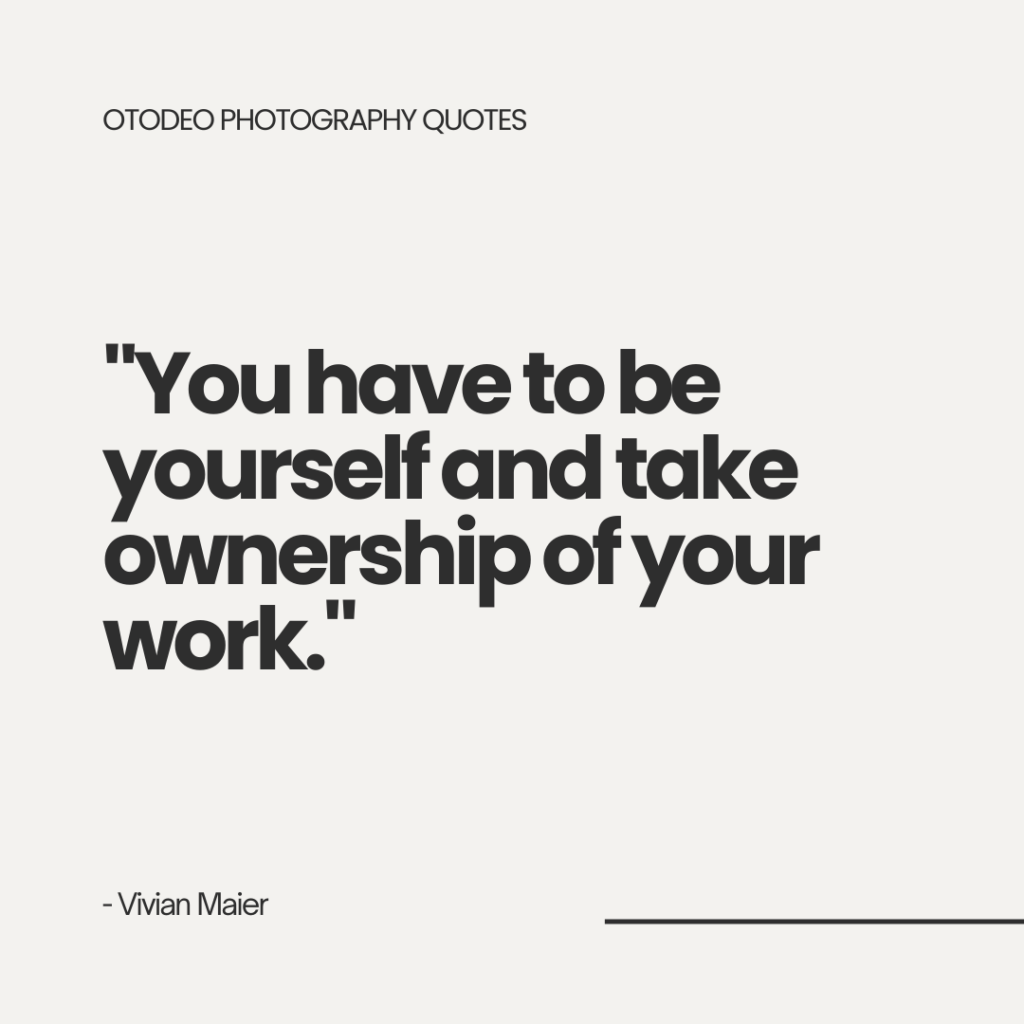
| “You have to be yourself and take ownership of your work.” — Vivian Maier |
The tragic irony of Vivian Maier’s story is that she took ownership of her work in the most literal sense — she hoarded it, kept it private, never published — and in doing so, never received a dollar for it during her lifetime.
The lesson here cuts both ways. You have to be yourself and take ownership of your work. But ownership without systems is just possession. And possession without contracts, copyright registration, and clear licensing terms is a business waiting to be taken advantage of.
Who Is Vivian Maier?
Vivian Maier was an American street photographer who worked as a nanny for most of her adult life while shooting over 150,000 negatives and rolls of film that she almost never developed or showed anyone. After her death in 2009, her work was discovered in a storage locker and eventually recognized as some of the most significant street photography of the twentieth century. She owned every inch of her creative output. She just never monetized, published, or legally protected any of it.
The Business Lesson: Ownership Means More Than Making the Image
In photography, ownership has a technical legal meaning and a practical business meaning, and both matter.
The technical meaning: in most jurisdictions, you own the copyright to every image you create at the moment of creation. The client who hires you does not automatically own your images — they purchase a license to use them, unless your contract says otherwise.
The practical meaning: if you don’t have a contract that spells out exactly what license you’re granting — for what use, for how long, in which media — you’re operating on handshake terms. And handshake terms get broken constantly, usually without the client understanding they’re doing anything wrong.
This comes up constantly for commercial photographers whose images end up on billboards, in national ad campaigns, or on product packaging after a contract that only specified “digital use for social media.” It comes up for wedding photographers whose images get used in vendor marketing without permission or credit. It comes up for portrait photographers whose client posts the images on a stock site or uses them for commercial purposes.
Take ownership of your work means creating the legal and contractual infrastructure that actually protects what you’ve made. That means a written contract on every booking. A clearly defined license. A usage clause that specifies exactly what the client can and cannot do with the files.
Vivian Maier owned everything. She just never built the system to make that ownership mean anything commercially. Don’t make the same mistake.
Real-World Application: Review Your Contract This Week
Pull out the contract you’re currently using. Find the section that describes the license you’re granting to clients. If there isn’t one — or if it says something vague like “personal use only” — that’s a gap worth closing.
At minimum, your contract should specify: personal vs. commercial use, the media in which the images can be used, the geographic scope if relevant, and what happens if the client exceeds those terms.
If you don’t have a contract at all, that’s the first thing to fix. Templates exist. Use one and customize it.
Take the Next Step
The OTODEO Booking System Playbook includes guidance on the contract and agreement phase of the booking process — so you’re protected before you ever pick up the camera. Get it at otodeo.com/booking-system-playbook.

More from OTODEO
- Quote of the Day – Joe Edelman on Treating Photography Like a Business and the System That Makes Consistent Bookings Possible
- Quote of the Day – Lara Jade on Relationships vs. Transactions and the Follow-Up Gap That Kills Photography Bookings
- Quote of the Day – Chris Burkard on Curiosity, Exploration, and Turning Your Photography Journey Into Content That Books Clients
- Quote of the Day – Martin Schoeller on Proximity, Clarity, and Why Photographers Who Niche Down Book Better Clients
- Quote of the Day – Platon on Trust, Safety, and the Photographer-Client Relationship That Drives Referrals